Doing it alone may feel like the cleanest answer
When your child says, “I can do it better alone,” there may be a real frustration underneath the words. Maybe the group chose a different plan. Maybe your child started before everyone had a part. Maybe a teammate changed something your child had already finished. Maybe nobody knew who was responsible for the next step.
You don’t have to decide what kind of teammate your child is from one difficult project. You can look closely at the moment and help your child find a more useful next move.
That distinction matters. “You’re controlling” turns a hard interaction into an identity. “You took the marker and finished the title before Maya chose a job” gives you both something specific to replay.
Ask before you explain
Begin with what your child saw.
You might say:
“Tell me the moment when it started going wrong.”
Then slow the story down:
- What was the group trying to finish?
- What had everyone agreed to do?
- What did you do next?
- What did the other person do next?
- Where did the work stop feeling shared?
You’re not asking your child to agree that everyone else was right. You’re helping your child separate the shared goal from the way the group tried to reach it.
Keep the goal and share the work
Sharing the work doesn’t mean every idea has to be used. It means everyone knows what the group is making and has a job that matters.
Here are three parts your child can practice:
- Name the goal. “We need a title that tells what our project is about.”
- Offer one idea. “I think this title is clear because it uses the main word from our topic.”
- Leave a choice for someone else. “Do you want to choose the final title, or should we each write one and compare them?”
The third step is easy to weaken. “You can pick which marker I use” sounds like a choice, but it doesn’t share much of the work. A useful choice can change the plan, the process, or the finished result.
Ten-second rewind
Replay the ten seconds after Fine, I'll do it
The most useful teamwork practice often lives in a very short moment.
Imagine that your child has explained the plan twice. Nobody has chosen a job, the clock is moving, and your child reaches for the paper.
The familiar version
The first version is familiar:
Fine. I'll just do it.
The work may get finished, but your child becomes responsible for the product and resentful about the people. The group never gets a chance to recover.
Replay the same ten seconds
Now replay the same ten seconds without asking your child to stop caring about quality:
We still need a diagram and three labels. I can draw the diagram. Who wants the labels, and when should we check that they match?
That line does three jobs. It shows what is left, names one job your child can do, and lets the group make a choice.
Try the replay with your child's real words. Keep the shared goal and change only the next line. If the new line still leaves your child holding every important decision, revise it once more.
Notice what your child may be protecting
Instead of guessing at a cause, ask a question that fits the moment.
If your child was worried about the quality, ask:
“What did you think had to be true for the project to be finished well?”
If the pace felt frustrating, ask:
“What could you do while someone else is thinking without taking their part?”
If the jobs felt unfair, ask:
“Which part felt like too much for one person? Which part didn’t have an owner?”
If your child’s idea was rejected, ask:
“What did you want the group to understand about your idea?”
These questions don’t excuse rude words or taking over. They help you find the exact skill to rehearse instead of assigning a broad label.
Use a family job to practice
Pick one short job. Before you begin, ask:
“What are we making? What job do you want?”
If someone starts doing another person's job, use the same short line from the activity:
“Can I have my job back?”
If you take over your child's job, say:
“Oops, I started doing your job. Do you want it back?”
Then keep going if everyone wants to continue. When you finish, name what each person did.
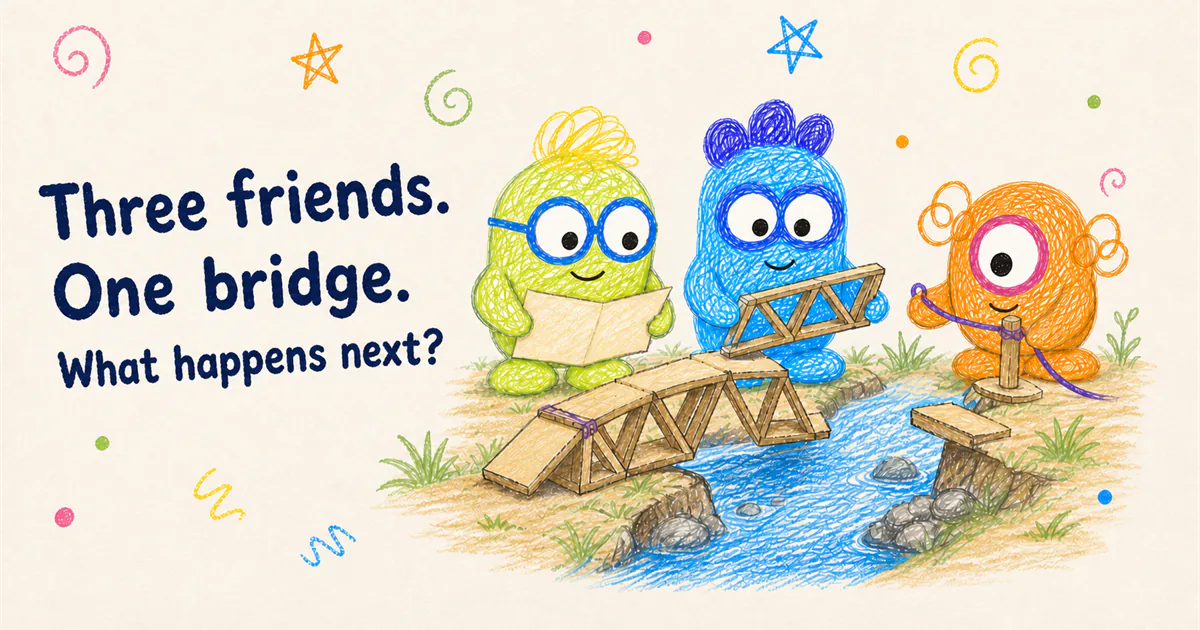
The Bridge That Needed Three Ideas
Open the short story with your child, choose what happens next, and talk about what changed.
Notice the work, not the personality
After the task, notice what happened.
- What did someone else do that helped?
- When did you make room for another idea?
- When did the team get stuck?
- What would you keep the same next time?
- What would you change?
Your child doesn’t need to announce that teamwork is wonderful. A useful close is smaller: they can name one thing someone did, one hard moment, and one next move.
Work with the teacher from a shared observation
The teacher sees the classroom group, the assignment, and the roles your child may not mention at home. You know the words and patterns your child brings home. Put those views together.
Try:
“My child described taking over the planning because the group hadn’t chosen roles yet. Is that what you saw? What language or role structure are you using in class that we could practice at home?”
Or:
“My child says it’s hard to wait when the group is deciding. What could they do during that pause that would help rather than take over?”
The purpose isn’t to prove who caused the problem. It’s to agree on one observable move your child can try and one kind of support the adults can give.
If your child describes exclusion, threats, or a safety concern, don’t treat that as ordinary teamwork practice. Bring the specific concern to the school and ask what happened and what support is needed.
Keep the next step small
One replay won’t settle every group-work problem. It can give your child one sentence to carry into the next shared task:
“Here’s the goal. I have an idea. Which part do you want to take?”
That’s enough for one practice.
Three Things Worth Remembering
Replay the moment. Describe what happened before deciding what it means.
Keep the strength visible. Your child can care about the goal without carrying every job.
Practice one line. Make room for someone else to help before the next hard moment.
Pause to Ponder
Think of one recent group-work moment. What was the group trying to finish? What was your child’s job? What job could someone else do?